

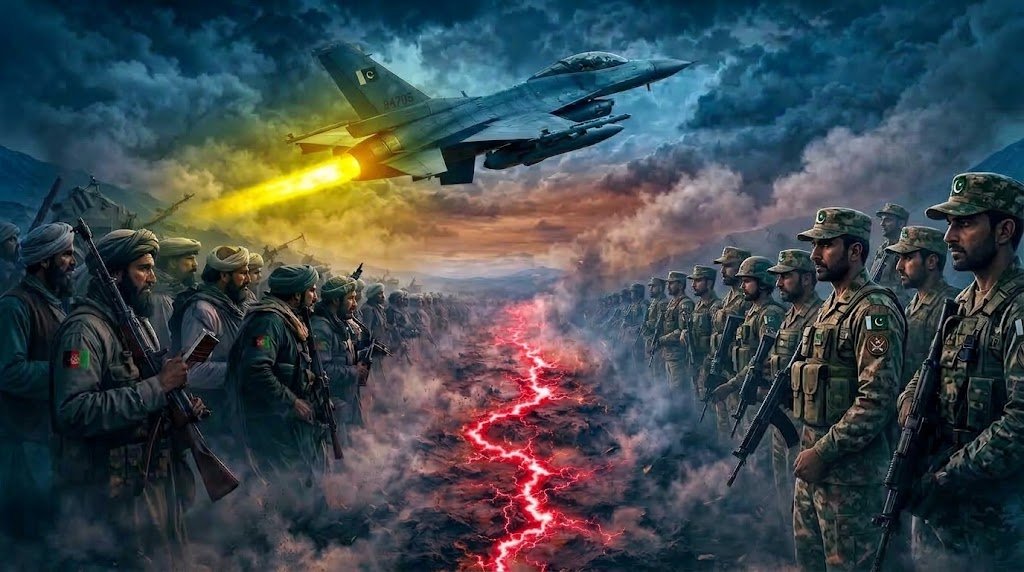
Right now, Pakistani and Afghan soldiers are killing each other. Pakistani airstrikes have hit targets inside Afghanistan. Afghanistan has launched military operations along the border. Pakistan’s own Defence Minister stood before cameras and declared the two countries are in open war. Dozens dead on both sides. Civilians among the casualties.
Two Muslim-majority nations. Both claiming Islam as central to their identity. Bombing each other.
If that does not trouble you, it should.
What Is Happening
Pakistan has suffered a wave of attacks from the Tehreek-e-Taliban Pakistan (TTP), an armed group operating from Afghan soil. Pakistan launched airstrikes targeting TTP leadership inside Afghanistan. The Taliban government retaliated. A ceasefire collapsed. The violence escalated. The UN confirmed dozens of civilian deaths and hundreds injured. Communities living along the 2,600-kilometre border are trapped between two Muslim armies.
Pakistan says it has no choice. The TTP killed over 1,000 Pakistanis in 2025 alone. Afghanistan says Pakistan is violating its sovereignty. Both positions contain some truth. Neither justifies what is unfolding.
The Real Problem: Nationalism
Here is the harder conversation nobody wants to have.
This conflict is not fundamentally religious. It is nationalist. Pakistan thinks in terms of Pakistani interests and Pakistani borders. Afghanistan’s Taliban government thinks in terms of Afghan interests and Pashtun identity. When those nationalist calculations clash, the Islamic brotherhood both sides publicly profess disappears almost instantly.
The Durand Line, the colonial border drawn by the British in 1893, is the fault line this war is literally being fought over. A line drawn by a British civil servant over 130 years ago is today killing Muslim men, women and children. Nationalism, in this case inherited colonial nationalism, is doing what it always does: dividing people along lines designed to serve empires, not communities.
Both governments wrap themselves in Islamic language. Both cite their duty to protect Muslims. And both are behaving exactly like the secular nation-states they claim to stand apart from.
Pakistan’s Forgotten Priority
There is something deeply painful about Pakistan directing its military might westward, toward a fellow Muslim nation, when to the east the people of Kashmir remain under occupation.
Kashmir is Muslim-majority land that belongs to Pakistan. That is not a contested opinion, it is the founding logic of Partition itself: that Muslim-majority regions would form Pakistan. India’s continued occupation of Kashmir is an injustice that has lasted over seven decades, and Pakistan was created with the explicit obligation to see it resolved. That obligation remains unmet.
And yet here is Pakistan, expending military resources and political capital fighting the Afghan Taliban, the very group it celebrated when they returned to power in 2021. Pakistan cannot claim the moral authority to speak for Kashmir’s Muslims while dropping bombs on Afghan Muslims. These positions are incompatible. They expose how thoroughly nationalist logic has replaced Islamic principle in the decisions of Muslim governments.
What Islam Actually Says
This is not political opinion but a clear Islamic position.
The Prophet Muhammad, peace be upon him, described the Muslim ummah as one body:
“When any part of the body suffers, the whole body responds with wakefulness and fever.”
Bukhari and Muslim
Allah says in Surah Al-Hujurat:
The believers are but brothers, so make peace between your brothers
49:10
The command is unambiguous. Not: make peace unless borders are at stake. Make peace. Full stop.
The Prophet also warned against Muslims striking the necks of one another. Fighting between Muslims was not treated as a political complication. It was treated as one of the gravest deviations a community could fall into.
None of this means Muslims cannot defend themselves. But when two Muslim nations reach open war, something has gone catastrophically wrong. Nationalism has won. Islam has lost.
What This Means for Us
The trap here is obvious: picking a side. Supporting Pakistan over Afghanistan, or Afghanistan over Pakistan, based on ethnic or national loyalty is itself an act of nationalism. It is the very disease the article is diagnosing. To fall into it while condemning it is hypocrisy.
The answer is not neutrality either. The answer is to reject the nationalist framework entirely. Islam does not organise the world by nation-states and borders. It organises it by aqeedah, by shared belief and shared obligation. The solution to Muslim nations warring with each other is not better diplomacy between those nations. It is the revival of an Islamic polity that binds different peoples, ethnicities and languages together under a single unifying framework, as it did for centuries. Nationalism dismantled that. Only its rejection can begin to rebuild it.
Unity is not a political preference. It is a religious obligation.
“And hold firmly to the rope of Allah all together and do not become divided.”
Surah Al-Imran (3:103)
