

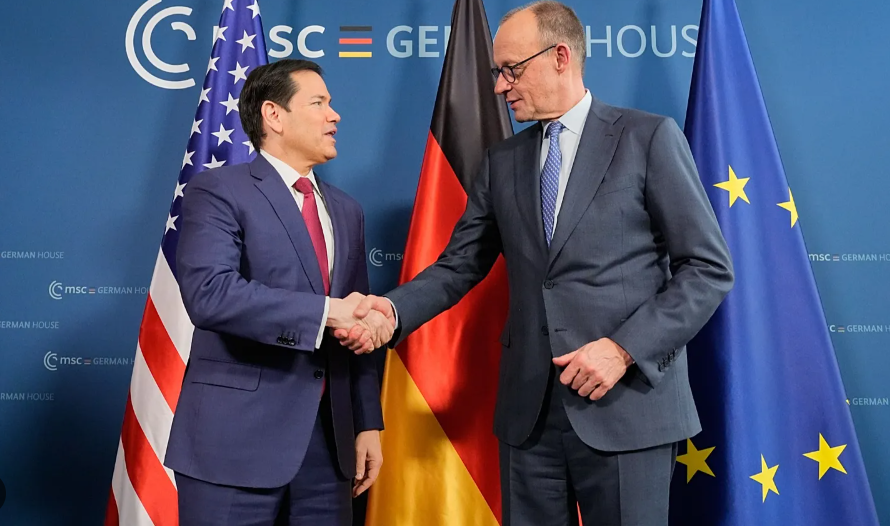
Let’s be honest about what the Munich Security Conference actually is.
Every February, the world’s most powerful governments fly their ministers and generals into a Bavarian hotel to sort out the planet’s problems. Sounds reasonable, right?
Except the problems they’re solving are usually the ones they created, and the solutions almost always benefit the same people. Funny how that works.
The Munich Security Conference isn’t some neutral forum for humanity to hash out its differences. It’s a Western institution, funded and shaped by Western interests, where the agenda is set long before anyone arrives. Ukraine gets discussed. Indo-Pacific tensions get a session. And the Middle East? The Middle East gets managed.
There’s a difference. Discussing a problem means you’re open to any outcome. Managing it means you’ve already decided what the outcome will be.
Muslim Land Gets Negotiated Away. Again
Western governments argue amongst themselves constantly. America and Europe clash over trade, over NATO spending, over who owes what to whom. But there’s one area of remarkable consensus: Israel. Whatever disagreements exist in that conference hall, the basic framework never shifts. Israel’s security is non-negotiable, and every other country in the region must orient itself around that fact.
Syria is the latest example. After Assad fell in December 2024, Israel moved quickly, launching over a thousand airstrikes on Syrian territory and sending ground forces into southern Syria. Not exactly the behaviour of a neighbour welcoming a fresh start. But was that discussed at Munich as Israeli aggression? Not really.
Instead, Syria’s new Foreign Minister Asaad al-Shaibani found himself on a panel essentially explaining why Damascus is willing to talk to the country bombing it. Everything is framed within the construct of “progress” and “give us time” but then came the bit that should’ve broken through the noise far more than it did.
When asked directly about the Golan Heights, Syrian land occupied by Israel since 1967, annexed illegally in 1981, not recognised as Israeli by any UN resolution, Shaibani admitted the negotiations simply weren’t going there. The talks, he said, were about Israeli withdrawal from areas seized post-December 2024. The Golan? “Another issue.” A separate matter. For another day, presumably.
Think about what that actually means. Syria’s government, fresh from revolution, already negotiating on terms that leave decades of illegal occupation completely off the table. Under US pressure, Damascus is reportedly moving toward intelligence-sharing arrangements with the very state holding Syrian land hostage. And Munich provided the backdrop, the legitimising stage, for that process to unfold politely, among friends.
This is what managing the Middle East looks like up close.
The World isn’t Buying It Anymore
Here’s the thing though, and this matters: young people around the World are paying attention in a way previous generations simply weren’t. The Gaza Genocide broke something open. The refusal of Western governments to call an obvious thing what it was, the vetoes at the UN, the weapons flowing while the speeches talked about “humanitarian concerns.” People clocked it.
You don’t need a politics degree to understand the Munich Conference. You just need to have watched the last two years and asked why the rules only apply in one direction.
Syrian protesters are already on the streets demanding their new leadership actually confront Israeli occupation rather than negotiate around it. That’s not radicalism. That’s people understanding what they’re watching.
Where Does This Leave Muslims?
Here’s the uncomfortable truth that no panel at Munich will discuss: as long as Muslim-majority nations seek their salvation through Western-designed frameworks, they will always arrive at Western-designed outcomes. You cannot enter a system built to exclude you and expect it to somehow liberate you.
The power of the Muslim world, and it is substantial, demographically, geographically, militarily, has never been the problem. The problem is authority. Fragmented, dependent, borrowed authority that requires approval from the very powers it should be independent of.
The solution isn’t another security conference. It isn’t more “realistic paths.” It isn’t intelligence-sharing with occupying forces.
Muslim destiny, as it has always been when things actually changed, lies in unity and independent authority rooted in Islamic principles. Not nostalgia. Not sloganeering. Actual, sovereign, self-determined governance that doesn’t need Munich’s blessing to know right from wrong.
The Golan Heights didn’t become “another issue” because of geography. It became “another issue” because Syria is negotiating from weakness, inside a framework designed by people who benefit from that weakness continuing.
That framework will not fix itself. It never does. The fix is Muslims grabbing destiny by their own hands
AWARE MUSLIM | Empowering Bold Minds
