

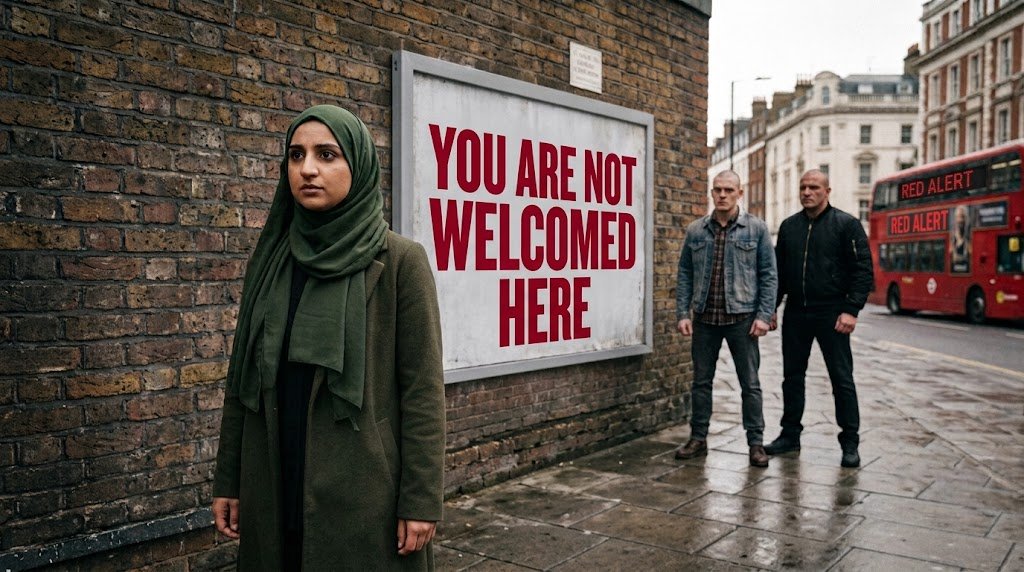
The word Islamophobia has shaped modern anti-Muslim and anti-Islam discourse in the last two decades or so. There is no single definition of Islamophobia, although some working meanings exist.
In the UK, the All-Party Parliamentary Group (APPG) on British Muslims defines it as “rooted in racism and is a type of racism that targets expressions of Muslimness or perceived Muslimness.”
The fact that there is no single, widely accepted definition is testimony to the strong belief, particularly among right wing commentators, that there is no such thing as Islamophobia other than an anti-Islam perception held by some Muslims. They argue that criticism of Islam is not Islamophobia and that any belief should be open to vigorous challenge, attack and even ridicule.
Whilst Muslims are not against debating the validity of Islam, insults, abuse and physical attacks on Muslims and their articles of faith merely due to their Muslimness can not be dismissed as healthy discourse.
There is also a deep undercurrent of racism in the attacks on Muslims since by far the majority of Muslims in the west are non-white, and the anti-Islam rhetoric is only a cover for racist bigotry.
Today an anti-Muslim and anti-Islam polemic is common, it is transnational and widespread, whatever it’s motivation.
Islamophobia’s tentacles spread from ideological criticisms of Islam to political, social, family norms and even the way Muslims dress and look. This should serve as a lesson to those who point the finger for Islamophobia at Muslims and their lack of assimilation:- to the Islamophobes it’s not aspects of Sharia creeping in to western society, which they are most vocal about, but it’s the mere existence of Muslims and Muslimness in public that angers them – whether it’s the niqab, hijab or even inanimate objects like mosques and minarets.
Among the so-called intellectual class this stems from the supremacist belief that Islam is a backward religion still rooted in 7th century Arabia with medieval laws and social norms. In their view Islam has not undergone the reformation that Christianity underwent 200 years ago but needs to undergo in order to be acceptable in the 21st century.
Politically, the West’s criticism of Islam cannot be disentangled from its illegal foreign wars and occupation of Muslim-majority countries. It is simply convenient for Western politicians to deflect their war crimes and justify foreign invasions to western public opinion if the foreign Islamist threat also exists domestically.
Here, the complicity of Muslim rulers in throwing their diaspora in the west under the bus also needs to be called out. From Musharraf of Pakistan post 911 to Zayed of the UAE today – these rulers have used political opposition to their rule to malign political Islam using the tropes of extremism and Islamism – a false narrative that has been seized upon by Western politicians and Islamophobes to call for rooting out a so-called home-grown extremist threat through programmes like Prevent, akin to the McCarthyism of the 1950s.
Extremism, Islamism, creeping Sharia or Islamisation of the western cities is the false narrative that has driven the Islamophobia threat. However, this narrative has been manufactured and has evolved over the last few decades. The term extremism was a post 911 narrative which became Islamism following the creation of ISIS and today any visible signs of Islam and Muslimness like businesses advertising halal food, women wearing the hijab, segregation of the sexes at public events is seized on as Islamisation.
The root causes of Islamophobia are ideological and political and exploit the weakness and disunity of the ummah. This therefore requires a commensurate ideological and political response. However, without an Islamic state, the Caliphate, to counter the negative propaganda and narrative, Muslims are left with expounding and exemplifying the charitable aspects of Islam to win hearts and minds in the west. Whilst this is necessary, it isn’t sufficient.
Firstly, the west would think twice about invading Muslim countries if a powerful Islamic state existed to protect the honour of the ummah. Without the war on Islam, the false justification of fighting extremism home and abroad disappears. Secondly, an ideologically powerful state would be able to demonstrate and propagate (dawah) how an Islamic ideological alternative to the current world order would practically solve global problems from hunger and poverty to oppression, thereby demonstrating the justice of Islam.
