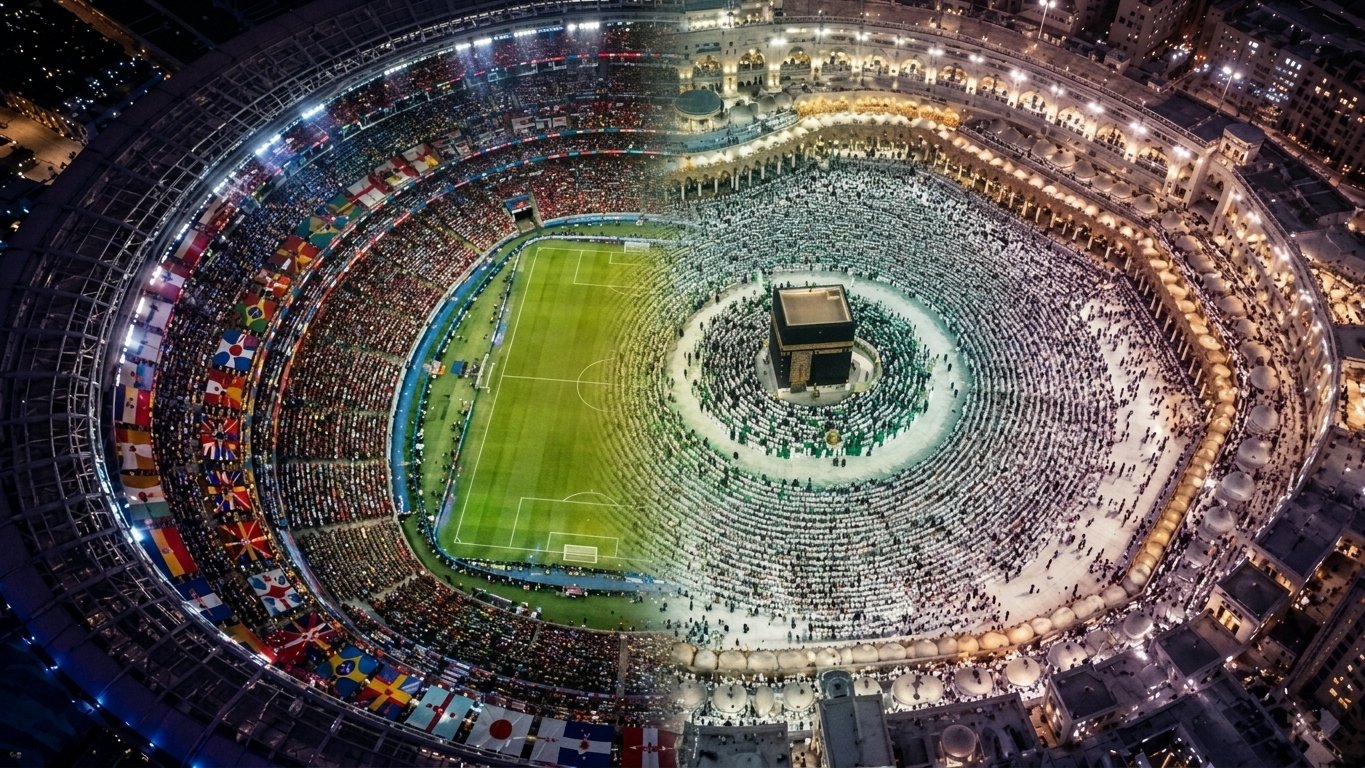
The football World Cup brings together 48 nations of the world competing for the title of champions. While we all love the football, the competition heightens nationalism, patriotism, pride, and loyalty to the nation above all else.
As Muslims, how should we see nationalism?
What does Islam say about nationalism?
In Islam, where should our loyalty lie?
Does pride in a land or where we’re born come before everything else?
The World Cup is a celebration of nationalism: standing for national anthems, honouring flags, lauding local languages, customs and traditions, and these supersede everything else. National pride is celebrated. What it means to be English is debated.
The nationalism that was despicable when burning down refugees’ homes a month ago in Northern Ireland is today celebrated for bringing pride back to a nation in crisis.
Nationalism is common and exists among Muslims too. We see the many Muslim-majority countries in the World Cup. Muslims who believe in one God and the last and final messenger Mohammad (saw), who follow one book, pray and do sujood to the same qibla, yet are divided by nation states and nationalism.
This nationalism puts people from a specific country, land, race, or tribe first and foremost, even though Mohammad (saw) said in his famous last khutbah that an Arab is no better than the non-Arab and a black person is no better than a white person. What matters is your taqwa, your obedience to Allah, your fear of Allah.
However, this is the same nationalism that immobilises the Egyptian army from coming to the defence of fellow Muslims in Gaza just a few miles across the border.
This is the same nationalism that divides super rich Saudi Arabian society from providing humanitarian aid to their brothers and neighbours in Yemen.
This is the same nationalism Turkey exploits to fight Kurds and to excuse itself from any responsibility to protect Palestinians.
So how did we get here?
Verily, we were a disgraceful people and Allah honoured us with Islam, so if we seek honour from other than Islam, then Allah will humiliate us
Umar ibn al-Khattab (RA)
We are in the month of Muharram, the first month in the Islamic calendar. Muharram is one of the four sacred months in Islam.
Muharram marks the start of the Islamic New Year. Umar ibn al-Khattab chose Muharram to start the Muslim New Year because that’s the date when Muslims emigrated to Madina and Mohammad (saw) became the leader of the Madina state. It was the start of a new Islamic civilization, a way of life embodied in a state, through laws, legislation, treaties, and the brotherhood of Islam, unified as an ummah.
Mohammad (saw) brought together the Ansar, the helpers of the Prophet in Madina, and the Muhajireen, the companions who emigrated from Mecca, into one brotherhood.
There was to be no difference between the Ansar and Muhajireen. The Ansar shared their houses and farms with those who had emigrated, leaving everything they had in Mecca. The Ansar knew what this brotherhood meant, to the extent that one is reported to have said, “I am happy to divorce one of my wives so that one of the Muhajireen could marry her.”
The Prophet (saw) instructed Bilal (r.a), the son of an African slave woman, to give the adhan in the masjid, to break the prejudices of colour and race, as well as freeman versus slave. None of these mattered anymore. The bonds of brotherhood based on La ilaha illallah, the oneness of God, superseded and abrogated all other loyalties.
The Prophet’s (saw) building of the bonds of brotherhood between the Ansar and Muhajireen, and his instructing Bilal (r.a) to give the adhan, sent a message to society of unity based on the deen of Islam. This was huge in a highly tribal society. The Prophet (saw) being the leader in Madina made this possible. It was clear for everyone that the Madina state was not built upon the nation-state model, but on La ilaha illallah.
This Islamic civilization grew and the state expanded under the caliphates of Abu Bakr, Umar, Uthman, and Ali, the rightly guided khulafah.
Then there were the dynasties of the Umayyads and Abbasids, and the capital of the Caliphate moved from Damascus to Baghdad. This was known as the Golden Age of Islam.
Even as recently as 100 years ago, under the Ottomans with the capital Constantinople, Muslims could travel from what is Turkey today to Damascus, Mecca, and Madina without a visa to perform hajj and umrah.
The First World War led to the break-up of the Ottoman state, and the drawing of the lines in the sand by colonial powers that created many of the nation states we see today.
The nationalities we celebrate and the lands we hold on to so dearly are around a century old in the 1448-year history of Islam. They are a blip in the timeline of Islam. They are the bitter fruits of colonialism. Yet some will fight and die for nationalism.
How is it that we accept this idea of nationalism when:
It is celebrating something we had no control over. Did any of us choose where we were born, the colour of our skin, or our parents and lineages?
It is celebrating the colonialism that divided the Muslims and removed Sharia from the Muslim lands.
It is celebrating the division of families separated by artificial lines drawn in Whitehall that changed the geography of the Muslim world overnight.
It is celebrating the division of the ummah that has made us weaker.
Umar ibn al-Khattab (RA) beautifully encapsulated the concept of honour in Islam with his famous statement: “Verily, we were a disgraceful people and Allah honoured us with Islam, so if we seek honour from other than Islam, then Allah will humiliate us.” For Umar, true honour lies entirely in faith, absolute submission to Allah, and justice.