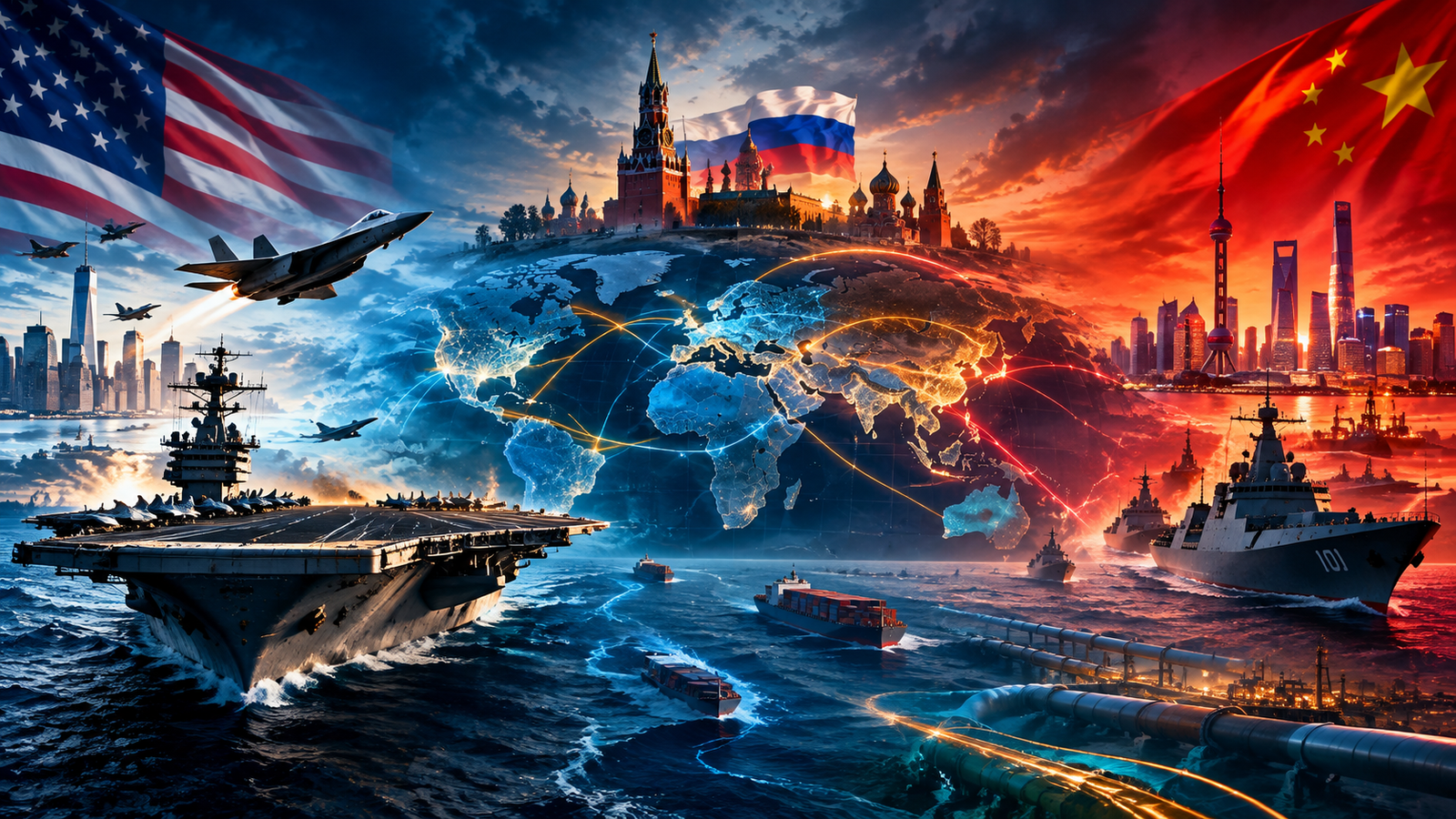
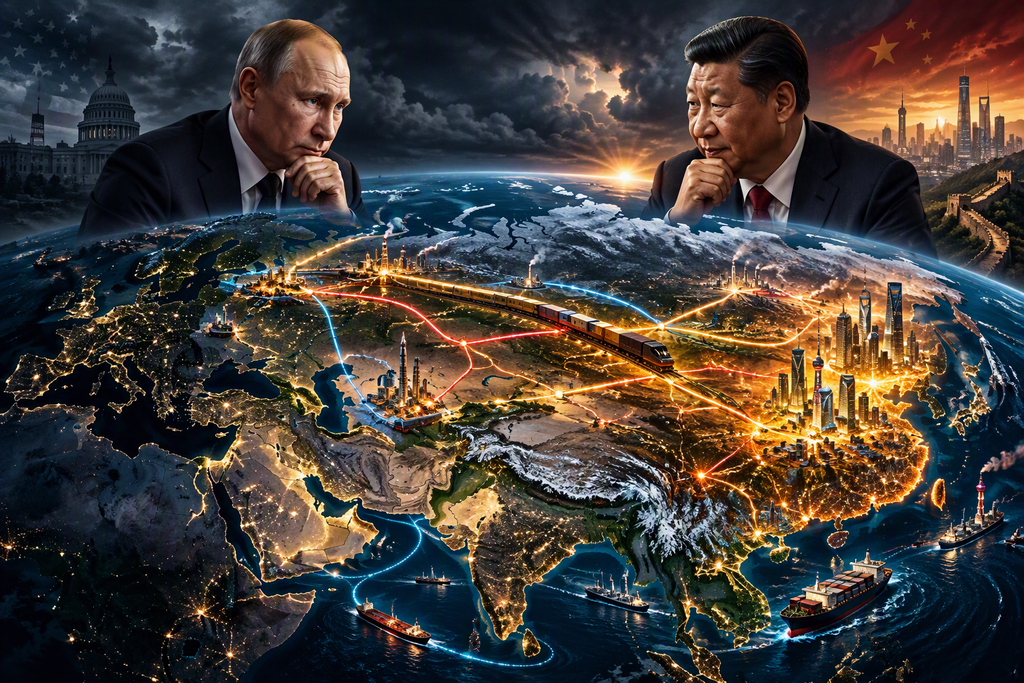
In February of 2022, China and Russia announced, an historic agreement to embark upon a strategic “no limits” partnership as a signal for the beginning of a new era in global international affairs, driven by technology transformations and globalised economic supply chains, and characterised by multipolarity, as opposed to the domination of the US-led Western exceptionalist global order of the preceding three decades. In a state visit to Russia in March 2023 Xi Jinping said to Vladimir Putin “There are changes happening, the likes of which we haven’t seen for a hundred years. Let’s drive those changes together.” The two leaders have developed a very close personal friendship and strong trust making both nations vested in protecting each other’s regimes
Following the 2022 announcement, Russia invaded Ukraine, which precipitated an unparalleled response from the collective West led by the US, including the G7 nations and the EU, involving sweeping economic sanctions against Moscow aimed to decouple the Russian economy from Western markets and the crippling of its military-industrial complex. Furthermore, NATO provided extensive military support to Ukraine including weapons, training and intelligence. After three years of bloody conflict, Russia’s economy has shown remarkable resilience in the face of the impact of the Ukraine war, and it has all but emerged as the victor in the conflict. A major reason for Russia’s success under the unparalleled sanctions regime can be attributed to its formation of strategic relationships, most importantly its partnership with China, which has allowed Russia to continue to export its vast hydrocarbon resources bypassing Western sanctions but also alliances with Iran and North Korea who have supplied weapons, including drones and artillery shells and soldiers.
Presidents Putin and Xi Jinping met again in May 2024 reaffirming the ‘comprehensive partnership’ and ‘strategic cooperation’ between the two states and a reiteration of their mutual contempt for “closed-door military and political alliances” led by the West.
On the Ukraine war, the message was clear and consistent, too – that the central node of tension is the existence of an unsustainable security architecture in the E.U., which requires a political solution with Russia and China on the table. Both leaders set out longer term goals when they co-wrote “Russian Chinese relations stand the test of rapid changes in the world, demonstrating strength and stability, and are experiencing the best period in their history. . .. [We] intend to increase interaction and tighten coordination to counter Washington’s destructive and hostile course towards the so-called ‘dual containment’ of our countries.” Overall, the recent Putin-Xi meeting, just like many of their meetings in the past, indicated that the China-Russia relationship is not just a “marriage of convenience” but is indeed a ‘no limits partnership’ just short of a conventional alliance.
It has become clear that the US led approach towards the Ukraine war has only consolidated the Russo-Sino partnership, pushing the two parties into increasingly deeper levels of cooperation in strategic areas including:
Energy: Pivoting away from now inaccessible EU market to China, massive deals like the Power of Siberia pipelines 1 & 2. This PoS1 pipeline, completed in 2019, delivers natural gas from Yakutia to China. It’s expected to reach full capacity of 38 billion cubic meters (BCM) per year by 2027. The PoS2 pipeline project aims to start delivering gas by 2030, with an expected capacity of 50 BCM per year. China has invested in Russia’s Yamal LNG and Arctic LNG-2 projects. Russia is exploring options for a new LNG pipeline from Sakhalin Island to China. There’s a possibility of Russia supplying up to 10 million tons of LNG to China annually, representing a significant portion of their total LNG production
Defence: Joint military exercises, arms sales, and technology transfers. – During the summer of 2024, Chinese and Russian warplanes flew in proximity, not toward each other, but in parallel, jointly probing Alaska’s air defence identification zone for the first time in history. The 2016 Joint Sea exercise in the South China Sea improved their ability to attack and seize an island—a drill with obvious parallels to Chinese ambitions in Taiwan. Between 2012 and 2014, Beijing and Moscow conducted nine joint military exercises. Since the Ukraine war, from 2022 until August 2024, they held fifteen. Russia and China’s joint military exercises have also included SCO and BRICS partners including recently Iran. Both partners have developed arctic patrol infrastructure which has established the arctic as a region of strategic competition with the US.
Diplomacy: Coordinated stances at the UN and on global issues. Only once before 2006 did Russia and China jointly veto a proposed resolution at the UN Security Council. As their national interests and policy objectives have increasingly aligned, however, the two states have vetoed sixteen resolutions together since 2007, all to thwart U.S. foreign policy objectives. In each of the nineteen cases since 2007 in which Russia exercised its veto power alone, China abstained. Indeed, Beijing has not opposed a Security Council resolution without Moscow since 1999. Every Security Council member voted in favour of a 2014 resolution to condemn Russia’s annexation of Crimea except Russia, which vetoed the resolution, and China, which abstained. China abstained once again when Russia invaded Ukraine in February 2022, while Russia vetoed a condemnation of its own actions.
Trade, Technology & Finance: In the first year of the war, China provided Russia with just over 40 percent of its total imports, and during the following two years bilateral trade surged from $146.9 billion to an all-time high of $240.1 billion. Circumventing Western financial institutions, Russian banks have signed on to China’s Cross-Border Interbank Payment System (CIPS), which saw its average transaction volume rise 50 percent in 2022 and another 25 percent in the first three quarters of 2023. Using CIPS and other platforms, trade between the two countries is increasingly conducted in Chinese yuan, which supplanted the U.S. dollar as the most used currency on the Moscow Exchange in 2023. The renminbi has since become the de facto reserve currency in Russia and in 2024, the share of bilateral trade denominated in yuan or roubles passed 90 percent, according to official figures.
The Russo-Sino partnership increasingly appears to serve as a strategic geopolitical pole to counter US global hegemony ironically leveraging many of the multilateral institutions created by the US and her allies to impose her political will upon the world. The partnership is arguably a key target of recent US foreign policy objectives under both the Biden and Trump administrations. This paper will discuss the historic trajectory of Russo-Sino relations and US policy towards it with a view to better understand recent events and how they will impact the dynamics of the global world order in the coming decade. We will touch upon how a nascent Khilafah state, once established, may view the Russo-Sino partnership and how it might navigate geopolitically in a new world order where the US no longer dominates.
Historical Relations Between Moscow and Beijing
While today’s Russo-Sino relationship is strategically grounded, the relationship has evolved significantly across historical periods ranging from imperial rivalry to uneasy Cold War comradery, and finally into today’s “no limits” partnership. In the pre-Soviet era, the Tsarist Russian Empire and Qing dynastic China were adversaries, clashing over territorial boundaries in Central and East Asia. Treaties such as the Treaty of Aigun (1858) and the Convention of Peking (1860) reflected Russia’s imperial dominance, carving out Chinese territories in the Far East.
The Soviet period introduced a new phase of relations—initially cooperative based upon ideological alignment after the Chinese Communist Party came to power in 1949, underpinned by Marxist ideology and Soviet support. However, ideological differences and non-aligned national interests began to emerge. Despite disliking Stalin, Chairman Mao rejected Khrushchev’s de-Stalinization and policy of peaceful coexistence with the West. In addition, armed confrontations on the Ussuri River in 1969, when China opened fire killing 50 Soviet soldiers following provocations, exposed deep mutual distrust which cemented the Sino-Soviet split culminating in decades of mistrust. The US president at the time, Richard Nixon, took this opportunity to open a dialogue with China, initially secretly through Pakistan. Released classified documents have shown that Nixon had been worried about a potential alliance between Moscow and Peking and decided that engagement with China was now possible, exploiting the fear in the Chinese leadership of a Soviet retaliatory attack on its nuclear infrastructure. That created an opening for Richard Nixon’s trip to China on Feb. 21, 1972, a diplomatic overture aimed at prizing China away from the Soviet orbit. In the short term, Nixon’s eight-day visit was an unambiguous success. According to a report in the NYT, Chinese leaders agreed to help spy on the Soviet Union.
Development of the Contemporary Russo-Sino Relationship
After the collapse of the Soviet Unionand beginning in the 1990s, relations thawed as both states sought pragmatic cooperation. Russia sought strategic depth after its Cold War retreat, and as China rose economically, both countries found common cause in balancing U.S. global dominance. Border issues were formally resolved by 2008 and the formation of the Shanghai Cooperation Organization (SCO) in 2001 and further bilateral treaties laid the foundation for strategic partnership built upon shared objectives of promoting anti-Western alignment among allies in order to achieve the aim of global multipolarity and economic complementarity (energy for tech/consumer goods).
This has accelerated in the 21st century, especially post-2014 Crimea and 2022 Ukraine invasions, as Western sanctions pushed Russia further into China’s orbit. Today, despite historical mistrust and asymmetries, the Russo-Sino alignment is driven by shared interests in challenging the US global hegemony. However, unlike the past, the asymmetry in the contemporary relationship is clearly in China’s favour. China is the stronger power economically, diplomatically, and increasingly militarily. This asymmetry shapes the relationship subtly—Russia often appears as the junior partner despite its huge nuclear arsenal and energy resources. China’s economy is the second largest in the world by GDP at approx. $18 trillion, compared against Russia’s $2 trillion, and in terms of Purchasing Power Parity, is larger than the US (PPP captures the relative price ratios, in national currency, of the same good or service across different countries). China’s GDP has risen by over 746% in the last 25 years, compared with an increase of 156% in Russia.
In terms of Trade Influence, China is Russia’s largest trading partner, while Russia is only a secondary partner for China. Western sanctions after the 2014 Crimea annexation and especially the 2022 Ukraine invasion have made Russia heavily dependent on Chinese markets for energy exports, tech imports, and banking services. China’s Technological and Industrial Base is globally competitive, especially in areas like telecommunications (Huawei), AI, drones, and electric vehicles. Russia lags—its economy is still heavily resource-based, with limited high-tech export capacity. Since 2022, Russia has been increasingly cut off from Western technology, making it more reliant on Chinese supply chains. In relation to population demographics and Global Connectivity, China’s population (over 1.4 billion) gives it vast labour resources and consumer markets while Russia faces severe demographic decline, with a shrinking workforce and brain drain, particularly accelerated since the Ukraine war. China is a central node in global supply chains and multilateral organizations like BRICS, SCO, and Regional Comprehensive Economic Partnership (RCEP), where Russia often plays a supporting role. Geopolitically, China has managed to balance engagement with the West and developing nations while deepening ties with Russia. It plays both sides more effectively. Russia, post-Ukraine, has become diplomatically isolated from the West and increasingly seen as a junior partner in a China-led bloc. Militarily, Russia has vast nuclear capabilities, combat experience, and a capable aerospace force. China, while untested in modern conflict, is rapidly modernizing its forces. It now has the largest navy by number of vessels and is demonstrating ambitious power projection plans (e.g., South China Sea, overseas bases in Djibouti) and through massive investment in missile technology, AI warfare, and cyber capabilities. Still, China exercises restraint militarily—not out of weakness but from strategic patience. It prefers to leverage long-game influence (economic corridors, debt diplomacy, digital silk roads) over blunt force.
So, while Russia is still a formidable military power, its economic stagnation, diplomatic isolation, and increasing dependence on China reduces its strategic autonomy and its long-term outlook remains challenging, hence it views its relationship with China as vital.
Foreign Minister Sergei Lavrov has said that enhancing ties with China represents Russia’s top foreign policy priority and Putin has provided political support for “China’s sovereignty and territorial integrity” in reference to its ambitions in Taiwan despite Russia ironically occupying 350,000 square miles of formerly Chinese territory. China, meanwhile, sets the tempo economically, diplomatically, and increasingly technologically—and thus, is better placed to dictate more of the terms in their “no-limits” partnership. Russian sinologist Vasily Kashin has acknowledged that Beijing will have greater influence in Russian politics and economics in the future stating “China will have the opportunity to use the levers of economic diplomacy to influence our political positions . . . [China] will have the opportunity to dictate prices. And we will have to live with this.” However, China also benefits from the partnership in several ways. Russia provides advanced military equipment, which has helped China modernise its military, and training as well as joint exercises to fortify China’s defence capabilities. It supplies vital energy to China’s domestic economy at discount prices. It represents a relatively modest but increasingly important destination for Chinese exports. It is a gateway for China to the Arctic and the critical Northern Sea Route, unlocking new avenues for the China’s trade and influence. Most important, Russia works with China to oppose what both Putin and Xi view as American refusal to accept the legitimacy of their political systems.
US Policy
The era in which the US has enjoyed unchallenged global dominance since the fall of the Soviet Union in the early 1990s has ended as she now faces global competition economically from China and increasingly political opposition from the Global South led by the China-Russia anti-Western axis. The US has for several decades sought to restrict China rise as a competitor and had indeed recognised China as a potential future economic rival since the Nixon presidency. Although Nixon’s policy of economic engagement with China was aimed to weaken the Soviet’s influence in the relationship, some US policy makers at the time viewed China rather than the Soviets as a potential future economic rival and indeed some claim Nixon himself later had misgivings about his policy, particularly given China’s support for the communist regimes in Vietnam and North Korea. Commentators have argued that certain policymakers oversold the benefits of engaging China and underplayed the risks to US interests. Steps by China toward a free-market economy didn’t turn it into a democracy, as many, most notably Bill Clinton, argued it would. And although a lot of American businessmen benefitted from China’s success and the American consumer from her cheap products, many American workers suffered when factories moved to China. While the US, dominated by the Neocons over the last 20 years, was preoccupied with the war on terror, China grew to become the indispensable node in the global supply chain with even the United States becoming increasingly dependent on the Communist nation.
As part of a strategic shift in policy from engagement to competition, the recent policy of the US since Donald Trump’s first term has been to weaken China’s export driven economy through tariffs and to encourage its subordinate partners to decouple from China’s exports. However, others argued that the US must weaken China’s own international partnerships for example by re conciliation with Moscow, i.e. what some have called “a reverse Nixon”! For instance, in 2021 Charles Kupchan of the Council on Foreign Relations stated that “as Biden builds a coalition to tame Beijing, he also needs to work the other side of the equation by weakening China’s own international partnerships. He can’t stop China’s rise, but he can limit its influence by trying to lure away from China its main collaborator: Russia.” Kupchan urged Washington to help “Russia redress the vulnerabilities that its relations with China put in stark relief.” This asymmetry in the Russo-Sino relationship is also a major focus of the current Trump administration. For instance, in October Trump declared: “the one thing you never want to happen is you never want Russia and China uniting. I’m going to have to un-unite them, and I think I can do that.” Such sentiments were also echoed by Marco Rubio when he recently commented that the US can’t let Russia become China’s permanent junior partner (Bloomberg).
the one thing you never want to happen is you never want Russia and China uniting. I’m going to have to un-unite them, and I think I can do that
President Trump
The Impact of the Ukraine War
The Russian invasion of Ukraine in Feb 2022 effectively ended the appetite in Washington for undertaking a “reverse Nixon” on Russia and China. With the US and its allies fully engaged in supporting the Zelensky regime with weapons, military logistical support and intelligence, military training and political and financial support, relations between Russia and the US reached a new low point under the Biden administration. In fact, as the war dragged on, the allied desire grew to convince Beijing to break the partnership. Analysts similarly discussed strategies to use the PRC to divide Russia and its other partners, most importantly North Korea. However, while China has publicly declared it’s neutrality in relation to the conflict, it has supported the Russian war chest by expanded purchase of Russian oil and gas thereby allowing Russia to subvert the impact of Western sanctions and it supplies nearly 80 percent of the dual-use items sustaining Russia’s war machine, according to the 2024 assessment by the Yermak-McFaul Expert Group. Therefore, China has stayed true to its partnership with Russia despite pressure from the US and its allies and despite the formation of a security alliance between Russia and North Korea. Thus, US support for Ukraine has not only attempted to weaken Russia but it has had the undesired effect of making her more dependent upon China thereby enhancing the Russo-Sino partnership and China’s ascendency in the relationship. Despite this apparent policy fallout, the Biden Administration appeared content to allow for a protracted conflict despite the destruction of Ukraine and the high level of casualties borne by both sides.
Given this backdrop, it is important to analyse why the US under Biden embarked upon this policy of targeting Russia via its proxy while choosing to build an Indo-Pacific security alliance (Japan, India, S. Korea and Australia & AUKUS) to contain China’s expansionist ambitions. There are several potential possibilities:
1. Immediate Threat Perception: Russia in the Russo-Sino partnership was the more overt and immediate threat to the Euro-Atlantic order. Its annexation of Crimea in 2014 and full-scale invasion of Ukraine in 2022 directly challenged European borders and NATO expansion. There is also legacy Soviet era phobia towards Moscow within Washington.
2. NATO-Centric Infrastructure: The U.S. has a deeply entrenched military and diplomatic presence in Europe. This made a robust response to Russian aggression feasible than a similar stance in the Indo-Pacific. Further Russia has a track record of resorting to military solutions while China displays strategic patience
3. Strategic Sequencing: Many in Washington viewed the containment of Russia as a prerequisite to focusing on China. The idea was to isolate and weaken Russia, thereby removing it as a potential ally for China in any broader anti-Western coalition.
4. Nuclear and Tactical Threats: Russia’s nuclear doctrine, including potential first-use scenarios, made it an unpredictable adversary. Deterring or degrading its military capacity was essential to maintaining broader global deterrence credibility.
Trump-Era Strategy: Chaos or covert
The current military situation in Ukraine with Russia regaining all regions in Kursk while maintaining its hold over the territories it has occupied (i.e. Crimea and parts of Donetsk, Kharkiv, Kherson, Luhansk, Mykolayiv, and Zaporizhzhya Oblasts) and Ukraine’s manpower severely depleted means that Putin has effectively achieved his primary aim of preventing NATO expansion to the Ukraine-Russian border and repatriating the ethnic Russian speaking Ukrainians. This reality on the ground coupled with instability in the ME has prompted the Trump administration to reverse US policy towards Russia to re-visit the reverse-Nixon strategy to the dismay of the Ukrainian leadership and their European allies including the UK. However, reconciliation of US-Russian relations and developing wider cooperation on several international issues is predicated on an end to the Ukraine war and US military support for Ukraine accordingly. Trump’s approach of unilateral talks with Russia to end the conflict without involvement of the Ukrainians or their European allies has generated much resentment and uncertainty in Europe about the reliability of the US as a security partner. The US’ apparent pivot towards Russia and away from Europe shows to what lengths she is prepared to potentially go to rebuild relations with Russia.
Tariffs
Coupled with its strategic shift to engage with Russia, the Trump administration has embarked upon the imposition of a global tariff regime, including a global 25% tariff on aluminium and steel imports, leveraging its massive import market to bring both allies and adversaries alike into line with the US goals of rebalancing her trade deficit and repatriating US manufacturing companies. The Trump administration claims the tariffs will raise $600bn per year in federal income which will allow the US to reduce corporation tax from 21% to 15%, figures many economic analysts challenge as highly overinflated. The policy of “tariff reciprocity” advocated by the Heritage Foundation Project 2025, cites perceived unfair trading practices by the US’ trading partners towards US exports for the trade deficit including imposing tariffs/barriers, subsidising domestic industries and currency manipulation, rather than its “exorbitant privilege” i.e. the US dollar reserve currency status and its consequently high value. Or as Donald Trump has explained it “everyone is ripping us off including our friends”!
The policy of tariff reciprocity, when analysed more carefully, is the weaponizing of trade for national security and geopolitical goals. It seems the US is abandoning trade multilateralism as enshrined in WTO principles and is moving towards bilateral, transactional and protectionist policies aimed to shift geopolitical alliances through changing trading practices. The size (245%) and ubiquitous tariffs imposed against China have singled her out, in violation of WTO principles (MFN), and has instigated a trade war between the competing rivals. Notably, both Russia and North Korea are not subject to the new tariff policy, with the US exempting both countries due to existing sanctions regimes! Furthermore, the 32% tariffs imposed upon Taiwan is a particularly strong diplomatic signal with potentially explosive implications. This is especially concerning given Taiwan’s strategic role in global value chains, particularly in the semiconductor sector, which is critical for the global digital economy. While some industries, like semiconductors, currently benefit from partial exemptions, the political message is clear: once sufficient on shoring of key component production has occurred in the US, disengagement from Taiwan cannot be ruled out. This signals an intent by the US to reduce technological dependence on East Asia in favour of greater strategic autonomy. The Taiwanese government have signalled that they will not retaliate and are actively seeking a trade deal with the US and its semiconductor giant TSMC has also announced plans to invest an additional $100 billion in the US. The Chinese have called the Taiwan’s government response akin to “turning the other cheek” and the “US-Taiwan relationship ” reducing Taiwan from a “pawn” to a “discarded piece.”
Therefore, the US tariffs are aimed to decouple China from global supply chains thereby restoring US industrial independence, particularly in key sectors relevant to national security e.g. semiconductors, weapons manufacture etc. In addition, the use of reciprocal tariffs can be deployed to cajole US’ historic trade partners such as Mexico, Canada, the EU and Japan and weaker countries like Taiwan who rely on US for security as well as exports, to potentially decouple from China.
Predicting the trajectory of the global order over the next decade
The pace of geopolitical change and the scale of US international diplomacy in the first 100 days of the Trump administration indicate that the US fully recognises that its global superpower status is facing an unparalleled challenge from an ascendant China and a risk-taking, aggressive Russia both of whom are more closely aligned and collaborative than at any time in their history.
The US has witnessed the loss of its power in the Indo-Pacific region to its economic rival, China, and Russia has effectively seen off NATO’s attempts to move further Eastward, via the accession of Ukraine with membership, through its high-stakes and hard fought “special military operation”.
“It would be a huge mistake for us at CIA and the U.S. government, or anyone watching that relationship, to underestimate the strength of the partnership right now: the sort of strong personal relationship between Xi Jinping and VladimirPutintheir sense of shared determination to undermine an international order that the United States has played a very large role in helping to shape.”
CIA Director William Burns in October 2024
Therefore, the Russo-Sino no limits partnership represents one of the most significant geopolitical developments of the 21st century.
While the US and its allies had built its post WWII dominance upon globalisation and an international rule-based order that promoted democracy and liberal values, the behaviour of the US in achieving its geopolitical objectives through brute military force, the destabilising of regimes through covert actions and the weaponisation of trade, while consistently violating its own rules based system, as occurred in the Iraq war and now witnessed graphically through its unlimited support for Israel’s genocide in Gaza, has only played into the hands of the Russo-Sino propaganda and making its vision for a multipolar world order attractive to “swing” nations such as those of the Global South. Furthermore, the US fully realises that a direct military conflict with either Russia or China would be catastrophic for either protagonist. Therefore, US policy is radically attempting to draw Russia away from China’s orbit and to restrain China’s growing influence obtained through its economic prowess with initiatives like the BRI. Therefore, the chaos of the Trump administration’s international policies needs to be viewed through the prism of countering the impact of the Russo-Sino partnership. Considering this analysis, we can anticipate a future global order where US power projection is increasingly reduced, international institutions irrelevant and regions of superpower influence are forged through “strength in diplomacy” style actions.
Were a new Khilafah state to emerge in this new world, perhaps in the Mediterranean and as Russian philosopher Alexander Dugin described in March 2025 post on X as “Neo-Abbasid caliphate can be the only solution of how make Islam great again – balance Sunni – Shia, Arabs – Persians – Turks, all 4 madhabs, flourishing Sufism, philosophy, science, art, culture. Real glory.”, then it needs to develop its own foreign policy with regards to the Russo-Sino partnership. It would be in the interest of the Khilafah to see the US and the collective West, its most belligerent adversary, weakened to the point of withdrawal from the ME and the Global South perhaps through an initial cooperation with Russia and China. Should this be achieved, the Khilafah with its leverage over central Asian Muslim countries would be best positioned to engage Russia with a “reverse Nixon” strategy to weaken China’s influence.
Most importantly, the Khilafah will have an ideology to offer humanity with a vision for the world where competition is replaced by true cooperation truly based on brotherhood and humanity and which solves the most fundamental problems of mankind, al Islam.