

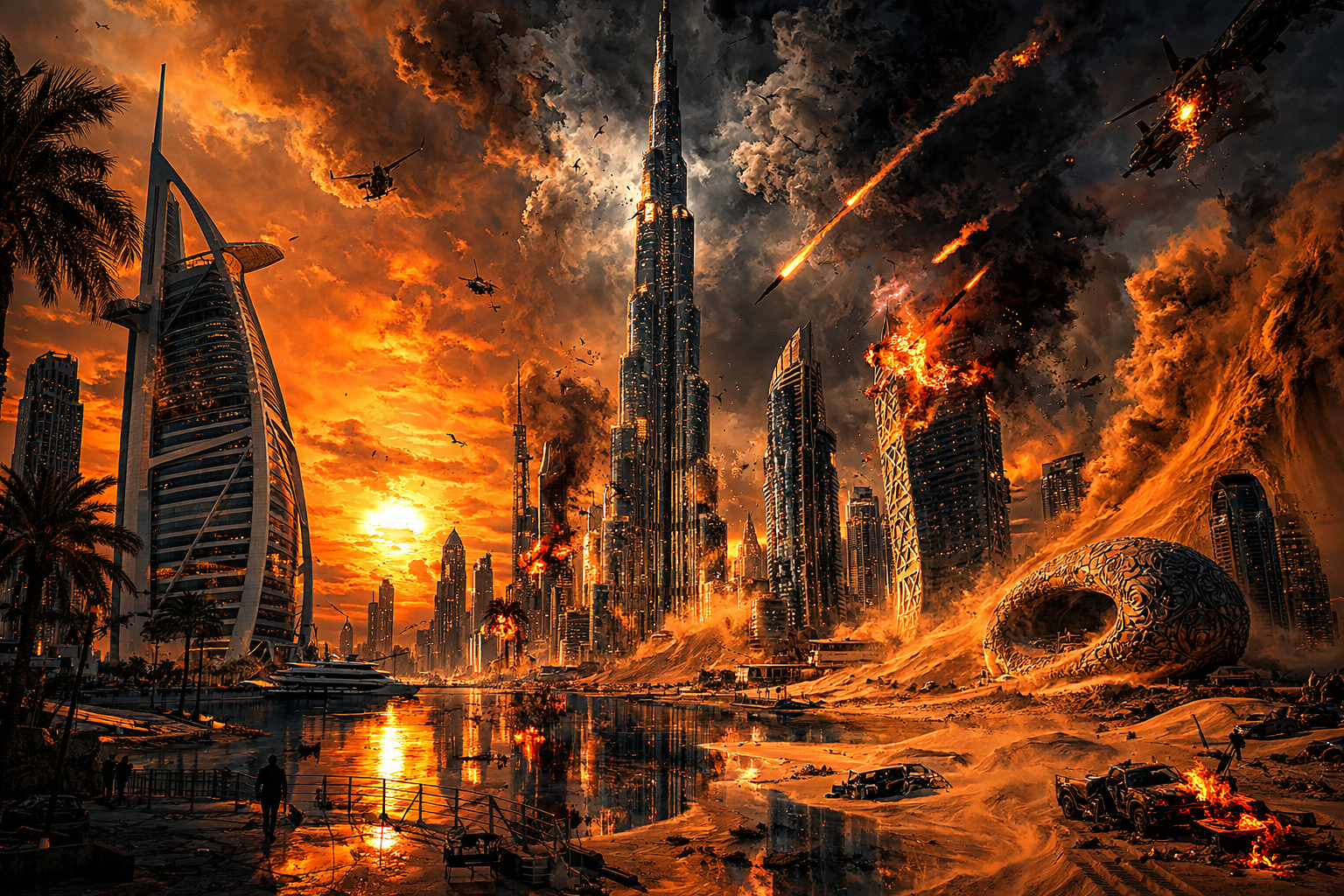
You have been watching the news. You have seen the missiles, the fires, the statements from Iranians and President Trump. What you are probably not being told is what this war actually confirms. Not about Iran or Israel in isolation, but about the Middle East strategic reality. Strip away the noise and three fundamental illusions collapse.
1. For Iran, Gaza Was Never the Point
For two years, Gaza burned. Hospitals were bombed. Children were starved. An entire population was systematically destroyed in the most documented genocide in human history. And Iran, the self-declared champion of Islamic resistance, the state whose currency was the rhetoric of liberating Palestine, did nothing of military consequence.
Then, the moment Israeli and American bombs began falling on Iranian soil, the missiles flew. Hundreds of ballistic missiles. Drones by the thousand. A full military arsenal unleashed.
The capacity was always there. The will was not. In November 2023, Khamenei told Haniyeh directly that Iran “…will not enter the war on your behalf.”
Iran’s so-called Axis of Resistance was never a pan-Islamic solidarity project. It was an instrument of Iranian state strategy, used precisely when Iranian interests were threatened, and withheld precisely when only Palestinian lives were at stake. The Palestinian cause was a brand. A recruitment tool. A geopolitical lever. When the lever was no longer useful, it was dropped.
Every Muslim who built their political identity around Iran as the protector of the oppressed needs to sit with that. Nation-states, regardless of their religious rhetoric, operate on regime survival logic. Always. The Ummah does not have a state that will sacrifice itself for Muslim solidarity. Pretending otherwise has cost us dearly.
2. US Bases in the Gulf Were Never There to Protect Muslims
The Gulf monarchies spent decades telling their populations that American military bases on their soil were a security guarantee. This war has demolished that argument in real time.
Qatar, the UAE, Saudi Arabia: all of them publicly stated before this war that they would not permit their territory or airspace to be used for any attack on Iran. They were ignored. The US launched operations from their soil regardless, with or without their consent and against their stated position. They had no veto. They had no leverage. For all the billions spent on American partnerships, they could not stop a war being started from their own land.
Then Iran struck back, and Muslim cities, busy airports, and key oil infrastructure absorbed the consequences. Gulf states found themselves running out of missile interceptors and being told by Washington that resupply was not immediately available. They had bought American weapons to defend against Iran. Those weapons were now being used to defend against strikes that American policy had caused.
There is a word for an arrangement where you pay for protection, have no say in how it operates, and end up worse off because of it. That word is a protection racket. The US bases in the Gulf exist to project American power and protect Israeli strategic dominance in the region. Gulf populations are an afterthought. This war proved it beyond any serious dispute.
Any Muslim leader who continues selling American military presence as a shield for Muslim people is either deceived or lying.
3. The Gulf States Are Mirages. Literally.
Dubai’s skyline is extraordinary. Abu Dhabi’s sovereign wealth fund is enormous. Doha’s infrastructure is world-class. None of it matters if you cannot defend it.
A single strike on Qatar’s main gas facility forced QatarEnergy to halt all production and declare force majeure on its international contracts, meaning Qatar could not meet its obligations to the world. One strike. A country that positions itself as a global energy power and diplomatic hub was paralysed in hours. The UAE absorbed over a hundred and sixty ballistic missiles. These are not countries that can absorb sustained conflict. They were never designed to.
The structural reality is brutal: tiny indigenous populations, no strategic land depth, no capacity to sustain a war economy, and an environment that becomes uninhabitable without continuous electricity and desalinated water. Hit the power grid and the water plants, and these cities empty. The skyscrapers are real. The strategic depth is not.
For years, Gulf states leveraged their wealth into influence: funding media outlets, buying Western political access, hosting global events. Many Muslims looked at this and saw Muslim power. What this war revealed is that wealth without genuine sovereignty is just expensive fragility. The moment a real military confrontation arrived, the entire model cracked.
Security outsourced is not security. It is dependency with a price tag.
What Now?
The Ummah needs a unified state built upon Islamic aqeedah, not the borders drawn by colonial powers to keep Muslims divided. Those borders are the architecture of our weakness. They are why the Ummah watches Gaza, then Sudan, then Kashmir as disconnected tragedies rather than a single wound on a single body.
Such a state would not calculate whether responding to oppression serves regime survival. It would not outsource security to the power that arms its enemies. It would be large enough, populous enough, and resourced enough to defend itself and respond to the oppressed from within, not from dependency on others.
Small states with outsourced security will always be vulnerable. Nation-states will always put survival above solidarity. Only a unified body grounded in Islamic aqeedah with genuine military strength ends this permanently
