

🎧 Audio Discussion Included
The NSS presents a sharply nationalist and realist reorientation of the execution of the American grand strategy. Its central argument is that the U.S. foreign policy – since the end of the Cold War – has lost its strategic discipline by pursuing global dominance, liberal internationalism, free trade orthodoxy, democracy promotion, and open-ended security commitments that exceeded America’s resources and weakened its domestic foundations.
The post WW2 era was dominated by an ideological struggle with the USSR and communism. This required the US to support and strengthen Europe in this battle and established an order with global institutions to enable it to manage this period. However, with the defeat of communism in 1990, the US became the uncontested sole superpower and witnessed a period of unparalleled influence and power projection. The need for European support no longer remains, nor is Russia or communism a threat to US global hegemony. However, the challenge from China compels a realignment of the strategy. We have entered a period of great power competition.
It recognises that the rules-based international order no longer serves its goal of global hegemony and a new order must be established. To create a new order, you have to dismantle the current order. Marco Rubio stated at the Munich security conference ‘the post WW2 global era is over and was weaponised against the US’
The strategy’s guiding principle is “America First”. This does not mean isolationism, but rather a narrower and more transactional use of American power.
This shift has been in the making for a number of years and this Trump administration has now made this dramatic change. The strategy treats domestic renewal as inseparable from foreign policy. It argues that America cannot remain a global power if its industrial base, border security, social cohesion, and national confidence are weakened.
Main principles
The strategy is built around several key principles.
- Peace through strength: Military, economic, technological, and cultural strength are the best ways to deter war.
- Flexible realism: The United States should work with countries as they are, not as Washington wishes them to be. No ideological promotion.
- Primacy of nations: The nation-state remains the central unit of world politics.
- Sovereignty and respect: America should resist international institutions or foreign actors that weaken U.S. sovereignty.
- Balance of power: The United States must prevent any rival from dominating a key region.
- Fairness: Allies and trading partners must stop free-riding on American security and market access.
Western Hemisphere: revived Monroe Doctrine
The Western Hemisphere is placed at the centre of American security. The strategy introduces a “Trump Corollary” to the Monroe Doctrine, arguing that the United States must prevent hostile external powers from gaining military, economic, infrastructural, or strategic footholds in the Americas. In origin President Monroe focuses on European powers interfering in South America, which could become a direct threat to the US. The outcome is that if you are declined or a receding power, you need to own your own backyard at a minimum, so this policy is a refocus on current global power politics.
The manner in which to achieve this includes:
- Stopping illegal migration [Build the wall, ICE]
- Defeating cartels and transnational criminal organisations. [bombing drug gangs]
- Preventing foreign control of ports, infrastructure, communications networks, and strategic assets.[ China and Panama Canal, TikTok]
- Near-shoring manufacturing and supply chains. Venezuelan oil is an example & Greenland.
- Expanding U.S. commercial and security partnerships in Latin America.
- Using American finance, technology, energy, and private-sector investment to displace rival influence, especially from China.
The Western Hemisphere is therefore treated as America’s primary security perimeter.
Asia: economic competition and military deterrence
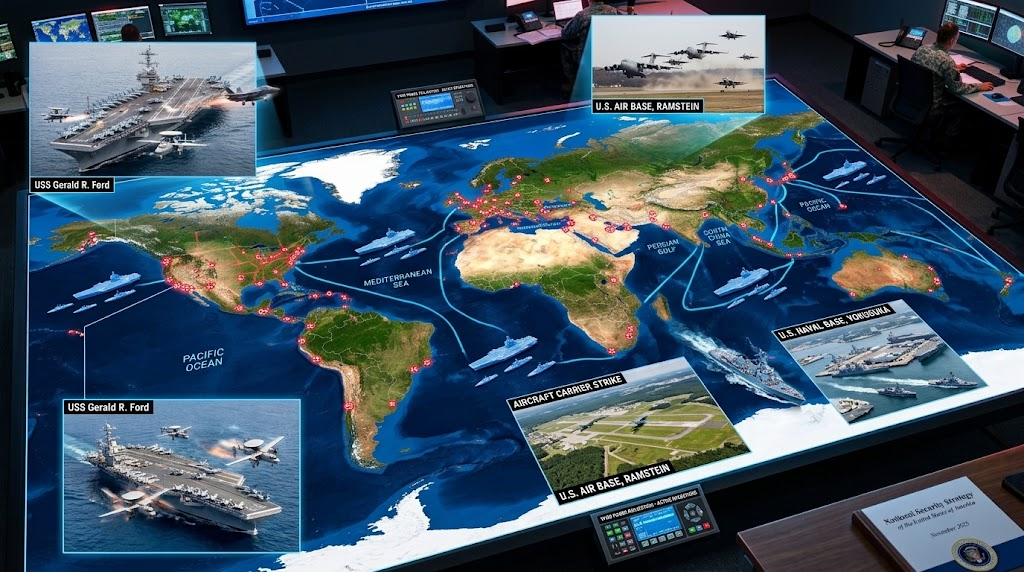
Asia is presented as the decisive theatre of long-term geopolitical competition. The region makes up 50% of global GDP. China is the main and only strategic global competitor, so the pivot is more refined and enhanced. The NSS argues that U.S. elites wrongly believed that integrating China into the global economy would liberalise it and make it a responsible stakeholder. Instead, China became wealthy, powerful, and more assertive. The US has silently recognised that China is the sole peer competitor in the military, technological, and economic spheres. The previous US Secretary of defence Lloyd Austin stated “China is the only country that can pose a systemic challenge to the US in the sense of challenging us economically, technologically, politically and militarily.” A strategic error which they are trying to rectify.
The strategy’s Asia policy has two objectives:
- Win the economic and technological competition by
- Reducing dependence on Chinese supply chains.
- Countering intellectual property theft, industrial subsidies, espionage.
Prevent a direct military conflict with China and preventing hostile take over of Taiwan and the South China Sea, by
- Working with their allies such as Japan, South Korea, Australia, India, and the Philippines in the military arena. In line with this strategy the US wants them to pay for the defence and US support. The establishment and strengthening of the Quad and AUKUS are further pillars to contain China.
The strategy sees the Indo-Pacific not only as a military theatre, but as the central economic and technological battleground of the 21st century.
President Trump’s recent visit to China, that was widely seen as a meeting of peers and which was evident by an usually subdued Trump, outcomes were an agreement for “strategic stability” for now between the two great powers.
Europe: burden-sharing and civilisational critique
The NSS argues that Europe’s problems are not limited to low defence spending. It claims Europe faces deeper challenges: economic stagnation, excessive regulation, mass migration, censorship, declining birthrates, weakened sovereignty, loss of national identity, and dependence on transnational institutions. It is quite damning of the direction of Europe as ‘a declined civilisation’, which J D Vance openly stated at the Munich Security Conference. Furthermore, Marco Rubio’s Munich speech set the framework when he stated ‘ the best period for the West was during the height of colonialism and of great power competition.’
The US reshaping of Europe is evident in the interaction and financial support of far right political parties and groups. The US supports separatist EU movements rather than the EU, JD Vance stated at the Munich Security Conference ‘The EU enemies are domestic’.
The one-sided EU-US trade agreement further confirms the demand on Europe to open its markets to U.S. goods and services. This is a fully transactional and dominant relationship.
Fundamentally, Europe must take primary responsibility for its own defence spending and improve its military capability. The US wants Europe to end the war with Russia and re-establish strategic stability on the continent. The damage inflicted on Europe by the US is complete and requires Europe now to stand on its own feet, without over reliance on the US. This allows the US to bulwark Europe against China, force it to resist Chinese economic coercion and technological theft. The longer-term goal is to pull Russia back into a stable European sphere and away from China as part of its wider containment strategy. Henry Kissinger and Zbigniew Brzezinski had repeatedly stated “that it would be a strategic error for the US to push Russia and China together and that the US must not allow this to happen”. For that Europe needs to resolve their challenges which is why you see the cultural critique and US involvement to facilitate changes.
Middle East: reduced priority, maintaining interests
The strategy argues that the Middle East should no longer dominate U.S. foreign policy as it did after 9/11, and therefore allow the US to accelerate the pivot to China. It wants a stable ME via the framework of expanding the Abraham Accords, which consolidates the Zionist entity as a major player in the region, along with others. The sell is mutual economic prosperity from political stability. The US will continue to use pressure, coercion, and force until they are able to manage the region in a more hybrid method, by establishing a regional security framework that polices itself. It will use multiple levers to achieve this, such as;
- Keeping the key waterways of the Strait of Hormuz and the Red Sea open.
- Preventing hostile control of Gulf energy supplies.
- Continued support, within limits, for Israel.
- Countering Iran.
- Supporting investment, energy, AI, nuclear energy, and defence technology partnerships with mainly GCC countries
- The end of the role for non-state actors Hamas, Hezbollah, SDF, PKK, Houthis, etc..
The document rejects nation-building, democracy imposition, and long-term military entanglements. The US wants to work with Middle Eastern states as they are, especially Gulf monarchies, rather than trying to transform them ideologically. Trump stated during his ME visit last May, ‘we do not want to impose our values, systems of governance, or counter your traditions’ and he further went on to say, ‘we don’t care what your women wear, what has this got to do with us.’
So in essence, they will continue to support autocratic regimes and dictators as long as they remain within the US sphere of influence; otherwise, they will seek to change them. However, the difference now is that they will have to pay more, and promoting ideological values is no longer the goal.
However, the current US and Israeli war against Iran has got the US in a quagmire by its own huribs estimations of its ability to change Iran into a more compliant regime as part of the ME strategy. Trump seems desperate to extradite the US out of what could become a further strategic error, a failure of US power projection and significantly impact the longer term pivot.
Africa: from aid to investment
The Africa section continues the rejection of an aid-led or ideology-led approach. Instead, it calls for trade, investment, energy development, securing critical minerals, and selective partnerships. This aims to counter the Chinese influence via its Belt and Road initiative, which has been very effective, and therefore opens African markets to more U.S. goods and services.
Removing old colonial influences aggressively will continue through the support of non-state actors, including Sudan, the DRC, Rwanda, and the Sahel region. In conclusion, Africa is viewed as a stage for strategic economic competition, particularly over key resources, critical minerals and future growth.
Conclusion
The NSS marks a major shift from liberal internationalism to nationalist realism. In this refocus, the US has dropped ideology promotion and returned to the days of hard power and pre WW2 period of imperialist hegemony and great power competition. It indirectly and reluctantly accepts the end of the unipolar world and a transition to multi-polarity. It is sceptical of global institutions, democracy promotion, mass migration, free-trade orthodoxy, and open-ended alliances. It sees rebuilding national power as the foundation for meeting the challenges in the new world order they are trying to shape, an acknowledgement that domestic weakness undermines foreign policy.
It recognises China as a systemic competitor and is recalibrating its strategy to reverse this error by building alliances with others to contain its growing influence. The US wants to avoid a direct clash at this point with China while they focus on getting the pieces into place. This requires reinstating strategic stability in Europe and a hands-off control of the ME as a reprioritisation.
However, the risks of success are significant. An overcorrection to transnationalism alienates allies. The cultural critique of Europe may also deepen divisions within the Western alliance, although Europe’s intent remains to hold onto the tail of the US regardless of what they do. Heightening tensions with China could impact progress in other areas. While there seems to be an underestimated difficulty of rebuilding industrial power, which is its foundational element for power projection. The US needs to reduce overextension and maintain credibility at the same time. A current risk at play is avoiding a further strategic mistake such as the Iran war.
Its success would depend not on rhetoric, but on execution.